Is FOSS losing to SaaS? — our FOSSASIA 2025 talk
Data from the CMS battleground: we scraped the site history of 9,000 UK non-profits to see how open-source CMS is really faring against SaaS. Short version — it's losing, with one exception, and it has a niche worth defending.
Our CTO Dylan Jay took a question to this year's FOSSASIA Summit in Bangkok: is open source losing to SaaS? Not as an opinion, but with data. We'd scraped the CMS history of thousands of UK non-profits and built a model to see where the market was actually heading.
You can watch the talk on YouTube, or flip through the slides.
Vibes versus data
The headless-CMS hype was loud. "42% of enterprises plan to adopt a headless CMS in the next 12 months," said Forrester. We were building our own open-source visual headless CMS at the time, so we had a stake in the answer, and we wanted more than a vendor survey. If only there were a very accurate dataset.
So we built the dataset
We scraped the website history of about 9,000 UK non-profits, taken from the public charity register: one live homepage per organisation, over 700,000 pounds in income, no spam. For each we classified the CMS over time and trained a model to predict when a site would switch. The categories: monolithic open-source CMS, licensed CMS, SaaS site builders like Wix and Squarespace, and headless CMS in both its SaaS and open-source forms.
The SaaS-ification of CMS
The trend was clear, and it ran the same way from both ends. Across roughly 6,500 UK non-profits from 2010 to 2025: offline and self-hosted site builders collapsed from about 43% to near zero; open-source CMS climbed to around 73% and then plateaued; SaaS site builders like Wix and Squarespace rose to about 18%; licensed CMS drifted down to around 5%; and headless, still small, kept growing. Site builders take the small, low-customisation sites; headless takes the large, high-customisation ones; the monolithic middle gets squeezed. AI is accelerating both.
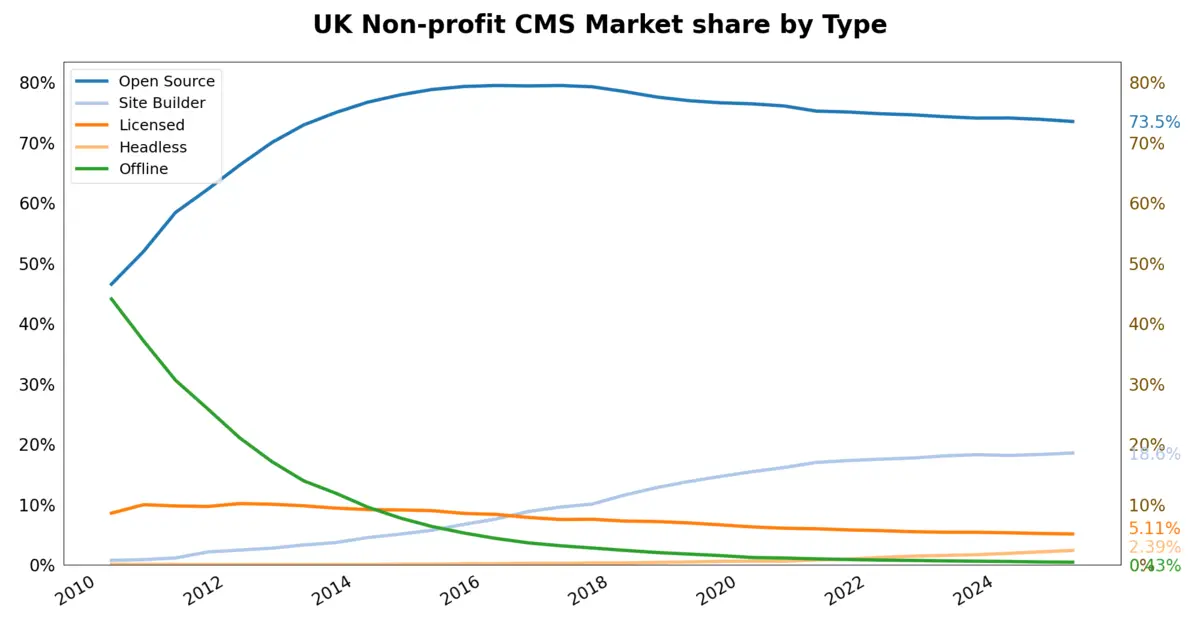
CMS market share by type across ~6,500 UK non-profits, 2010–2025. Open source plateaus, offline site builders collapse, SaaS site builders climb.
The same split shows up whether you slice by site size or by organisation budget:
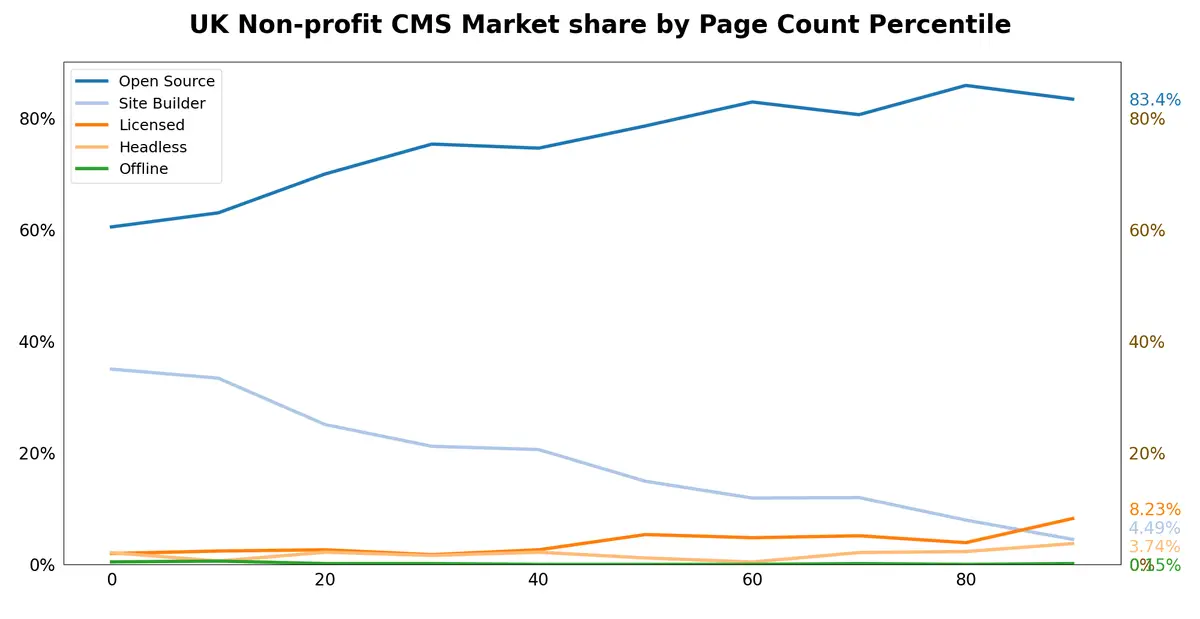
By site size: among the largest non-profits (top page-count percentiles), open-source share climbs to ~83% while SaaS site builders fade — they take the small, simple sites.
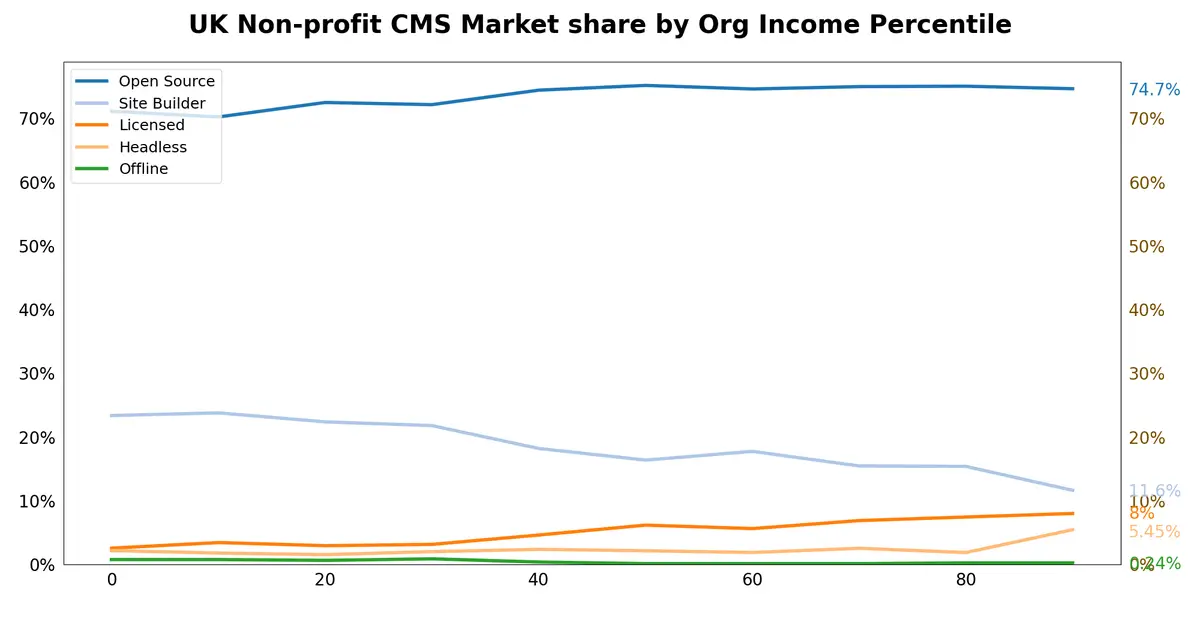
By budget: open source reaches ~75% among the highest-income non-profits. The bigger and better-resourced the organisation, the harder it leans open source.
Is open source losing?
Mostly, yes, with one exception. WordPress still holds around 62%, but it has stopped growing, and a VC-backed company that needs growth and can't find it has started turning on its own community. Licensed CMS is dying. Headless and site-builder SaaS keep climbing. So open source is losing share, but it isn't disappearing.
Open source still has a niche
Where open source keeps winning: data sovereignty, high security, intranets, and custom admin interfaces. The public bodies and regulators we work with need exactly those. But increasingly that niche is served by open-source headless CMS rather than the old monolith.
The "not visual" problem
One finding stuck with us. Editors rank a CMS on user experience, and by that measure headless comes last: you gain developer freedom but lose the friendly, visual, in-context editing a good monolith gives editors. Good UX is a real differentiator, and scratch-your-own-itch engineering tends to produce bad UX. Closing that gap is exactly what we're building.
Did the model actually work?
For the curious: it beat the naive baseline comfortably. Predicting a CMS change in the next 6 to 12 months, the model reached 0.84 accuracy with 0.77 recall on the "will change" class, against 0.67 accuracy and 0.33 recall for just using the average CMS lifespan. Not bad for a side project built on scraped charity websites.
If you're weighing open source against SaaS for a site that has to be secure, sovereign, and genuinely editable, that's our patch.