AI search across regulator complaints and oversight data
A government oversight agency wanted to use AI to make its public information usable — for journalists, the legal community, citizens, and its own staff. But it had to be right: the real questions are things like “How many complaints were upheld in 2024?”, “What did this regulator say about issue X?”, “Show me the latest investigation summary on Y” — where a confident wrong answer is worse than none. We helped them adopt AI over their own content in a way they could stand behind.
Background
Standard search across the agency's website returned long lists of partly-relevant documents and forced users to read each one to find the answer they wanted. Generative AI answer-quality on the same content was poor without context grounding: hallucinated specifics, no citations, no way for the user to trust or verify.
The brief was to deploy a citation-grounded AI search experience over the agency's own corpus — annual reports, media releases, investigation summaries, and the PowerBI dashboards that publish complaints and oversight data. No data was to leave the agency's boundary.
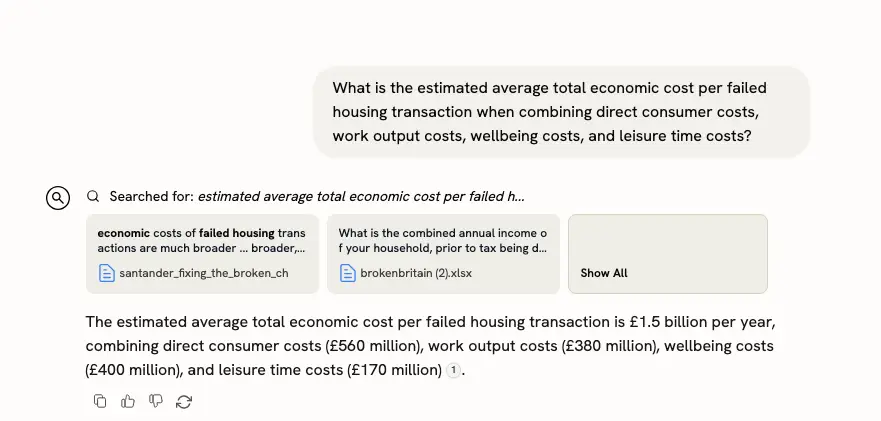
Solution
Getting it right meant keeping the AI inside the agency’s own material and making it compute, not guess. We used Onyx (the open-source, self-hostable RAG platform) with the connectors their stack needed — particularly PowerBI dashboard scraping for the structured oversight data — and our TableRAG pathway, so computational questions across the dashboards, like complaint totals by category and year, get computed answers, not retrieval guesses.
PDF extraction was tuned for the agency's annual-report layout, with cross-page table merging and proper handling of investigation summary structure. The deployment runs scale-to-zero on Fly.io between requests, with eight specialised Onyx workers split off the standard monolithic worker to keep idle cost negligible.
Example Questions Answered
“How do I make a formal complaint?” “Where can I download the latest annual report?” “What powers are available under the oversight legislation?”
Instead of manually searching documents or clicking through menus, users get immediate answers linked to authoritative content — and only that content. The AI answers from the agency’s own material, never the model’s outside knowledge, and declines a question it can’t ground rather than guessing. For a regulator, an answer that can’t be traced is worse than none.
Deployment Highlights
Feature | Detail | |
Setup time | --> | 3 weeks from engagement to pilot |
Data sources | --> | All public webpages and PDFs |
Transparency | --> | Answers cite source documents and pages |
Governance | --> | Fully monitored and tuneable |
Maintenance | --> | No scripted flows needed |
Benefits
- Faster, more inclusive access to complex public sector content
- Reduces staff time spent on routine enquiries
- Boosts user confidence in the agency’s transparency and responsiveness
- No new content creation — answers are drawn from what’s already published
- Ongoing optimisation via real-time query logs and content refinement
Outcome
End users now ask natural-language questions and get cited, defensible answers drawn from the agency's own published material — including computed answers across the PowerBI data that previously couldn't be queried this way at all. The deployment remains in production under the agency's data-sovereignty controls; no data leaves the agency's boundary.
See it in actionClient is anonymised in this case study at their request. We're happy to discuss the engagement in detail under NDA.
What this involved
Onyx, the open-source self-hostable RAG platform, deployed with the connectors the agency’s stack needed — including PowerBI dashboard scraping for the structured oversight data
Our TableRAG pathway answers computational questions across those dashboards — complaint totals by category and year — by computing them, not by retrieving a passage and guessing
PDF extraction tuned to the agency’s annual-report layout, merging tables that run across pages and handling investigation-summary structure
Answers are grounded in the agency’s own material with citations, and the system declines a question it cannot ground rather than inventing an answer
No data leaves the agency’s boundary — the platform is self-hosted, not a third-party service
Runs scale-to-zero on Fly.io between requests, with eight specialised workers split out of the standard monolithic worker so idle cost stays negligible